case study / internal software
Software Trilot builds for itself.
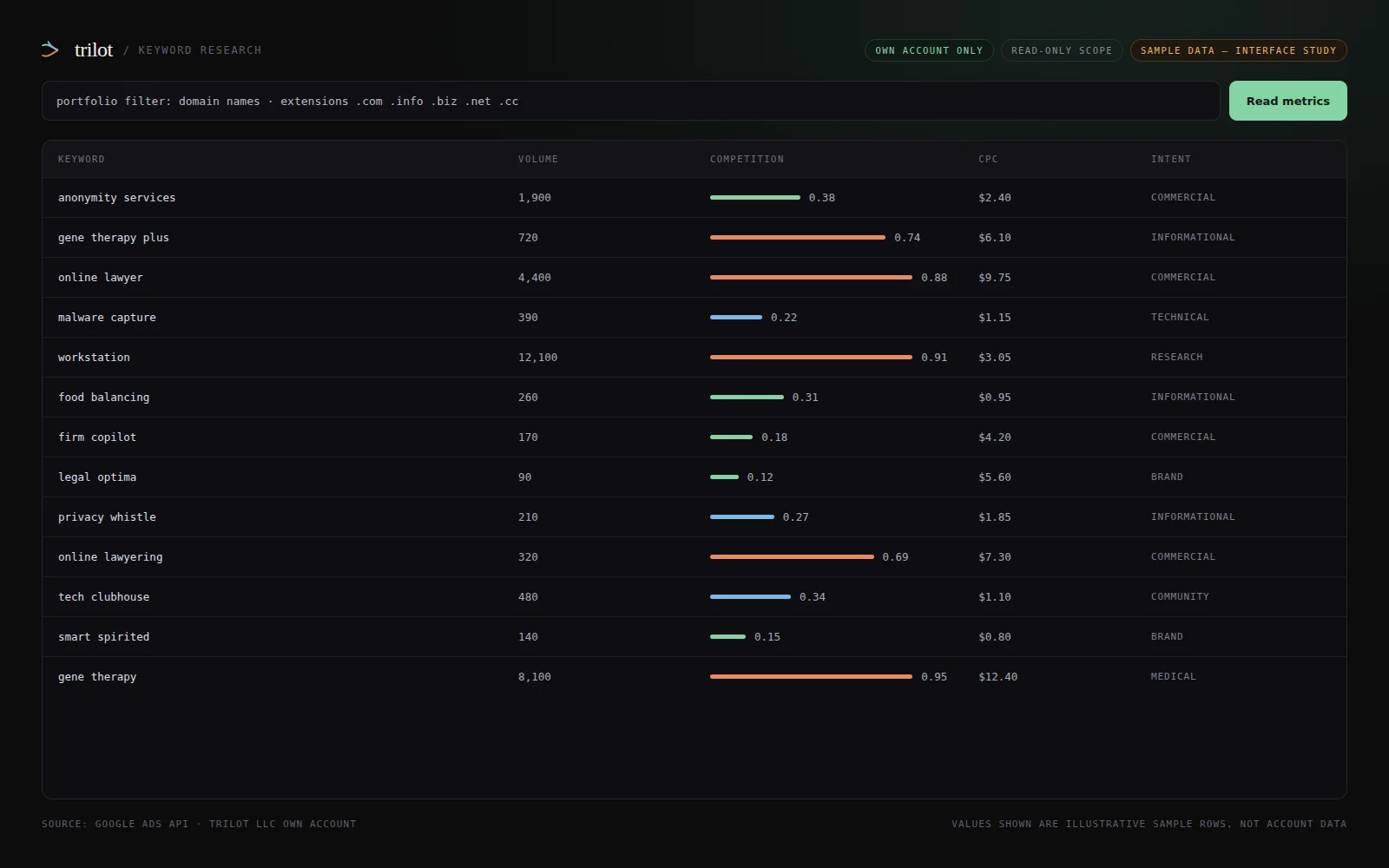
Trilot LLC operates its own software. The current internal application reads keyword metrics from the Google Ads API — search volume, competition and cost-per-click estimates — for the domain names the company evaluates for its own portfolio. One account, one reader, nobody else.
The brief
Trilot has been registering domain names since 1999 — bought on instinct, held on principle. The public domains page shows a selection from the portfolio by extension: 17 .com, 11 .info, 6 .biz, 3 .net, 2 .cc. It says plainly that it is not a full inventory and not a sales catalog.
Deciding what to keep, renew or let go is a research question with a few parts. Is anyone searching the term? How competitive is it? What would a click cost? The answers are public; the portfolio they are being asked about is not.
The brief was to answer it inside the company, on the company’s own account, with no third party standing in the middle of a decision about names held for years.
What we did
We built an internal application that connects to the Google Ads API and reads keyword metrics for the terms the portfolio is measured against. The design constraint came before the code: the tool should be as narrow as the decision it serves.
- Own account only. The tool reads Trilot LLC's own Google Ads account — no client accounts, no borrowed data, no third-party accounts.
- Three metrics, one question. Search volume, competition and cost-per-click estimates, read against the terms the portfolio is judged by.
- One user. Internal analysis by the company's owner. No seats to hand out, no dashboard for anyone else to log into.
- Never shared, sold or transferred. Account data does not leave the company, in any form, to any third party.
- Stated in public. The scope of the tool is described on trilot.com and linked to the privacy policy and terms of service — a boundary you can read beats one you have to trust.
Everything else was left out on purpose. No account system, because there is one account. No sharing layer, because nothing is shared. No second audience, because there is one reader — the person who owns the portfolio.
What shipped
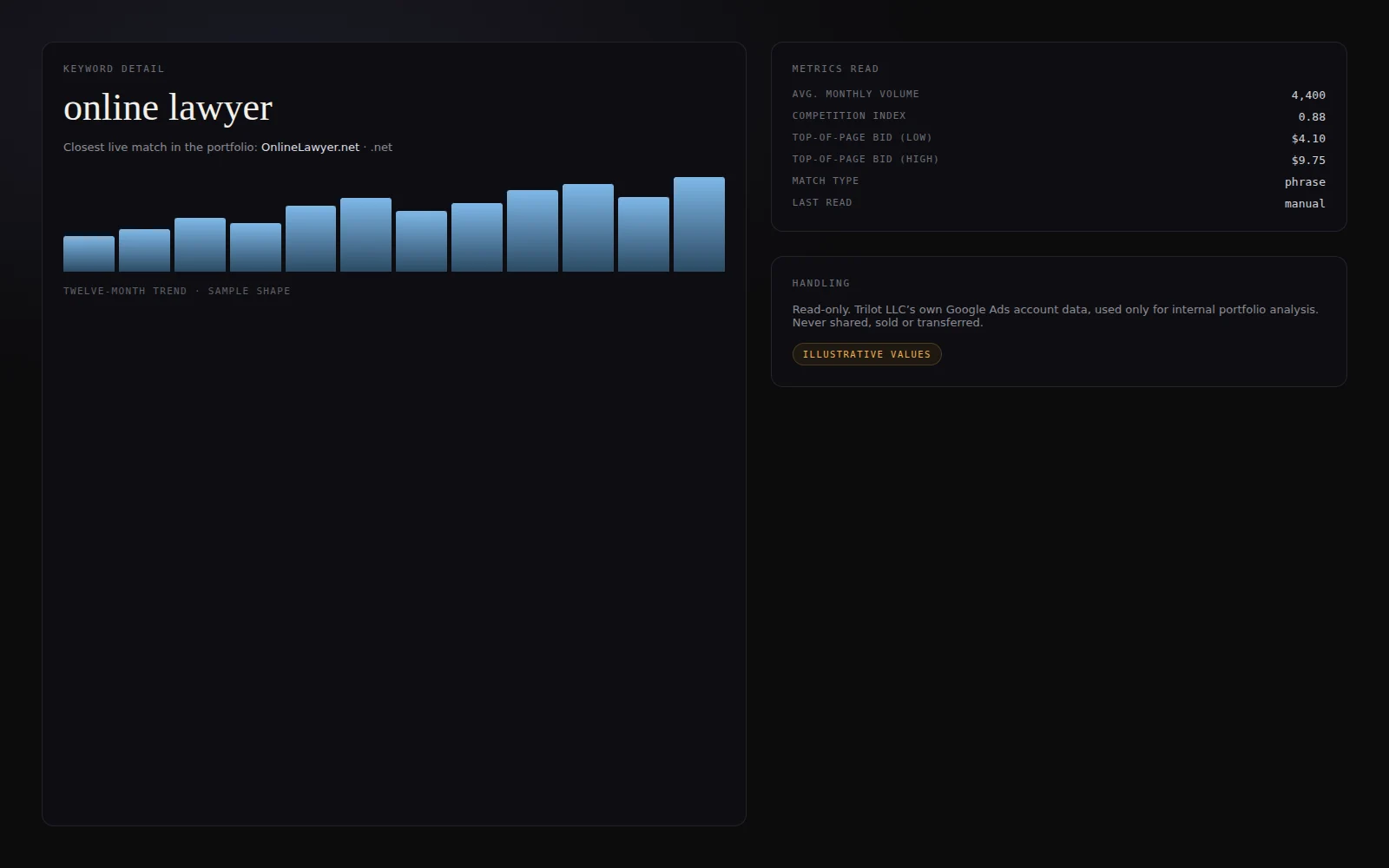
A working internal application that puts Google Ads keyword metrics next to the domain names Trilot evaluates for its own portfolio. It is in use, it is operated by the same person who reads it, and it is not a product: no signup, no free tier, no waitlist.
The account boundary is not a footnote. The tool accesses only Trilot LLC’s own Google Ads account, is used solely for internal analysis by the company’s owner, and is never shared, sold or transferred to a third party. That sentence is published on trilot.com, next to links to the privacy policy and the terms of service, so the claim is checkable rather than implied.
The portfolio it serves stays private by design: the domains page shows examples by extension and stops there.
What it proves
Trilot builds software for clients and for itself, and the internal work follows the same rules: an API integration, a surface for the operator, and a boundary written down before anything is connected.
It also shows that a useful internal tool can be narrow. This one does not track anyone and does not need roles or permissions, because the only person who opens it owns it. Narrow scope is what keeps the privacy claim to one sentence.
It is the operator’s discipline applied to tooling: build the smallest thing that answers the question, then leave it alone.
Engagement notes
This is not client work and not a service line. There is no client, no engagement letter, no invoice: Trilot LLC built the tool for itself and operates it for itself. It is here because it is software the company runs, and because its constraints are the ones clients ask about most often.
The nearest line in the service list is web & software development, where internal tooling and API integration are both in scope. When a client wants this shape, the engagement is scoped the way the tool was: name the single question, name the data it may touch, write that boundary down from week one, and build only what answers it.
Platform work under the same line runs six months and up. Smaller, narrower problems are sized to the problem. The first conversation is where that gets sorted out — book the call and describe the question, not the feature list.
Sourcing: this page describes an internal application built and operated by Trilot LLC, not a client project. The tool is used only for internal analysis by the company’s owner, and its account data is never shared, sold or transferred. No usage, revenue or performance figures are published, and none are implied.